 PetPussyCat
How to Keep an Indoor Cat Active in a Small Apartment
Keep an indoor cat active in a small apartment with vertical routes, short play sessions, food puzzles, rotation, and a practical seven-day plan.
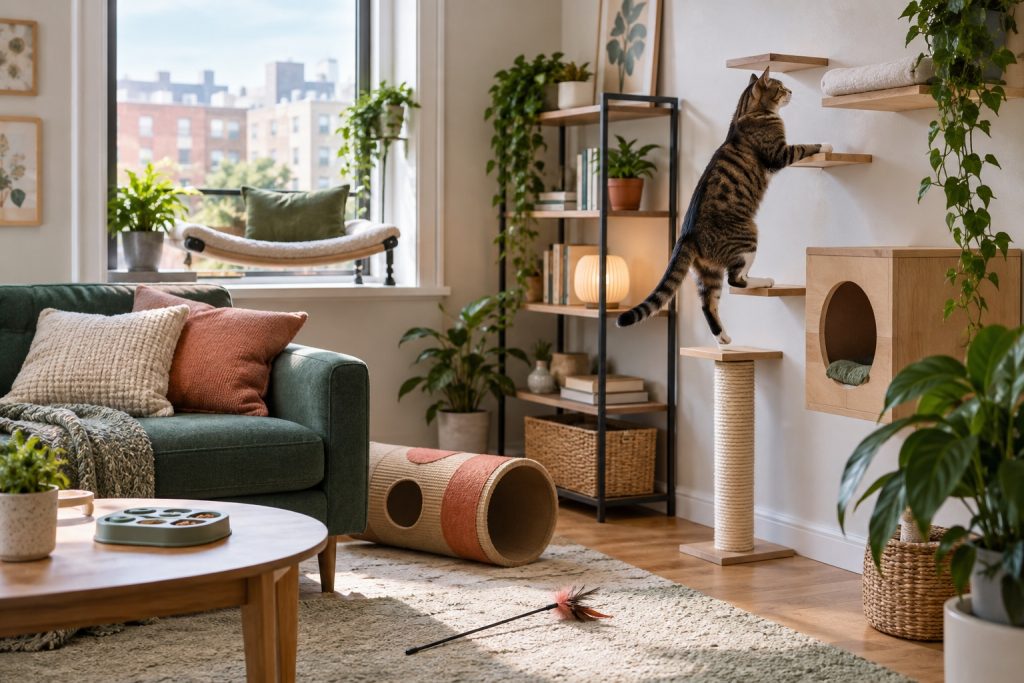
A small apartment can support an active indoor cat when the space offers choices: places to climb, hide, scratch, observe, forage, and play. Floor area is only one part of the environment. Vertical routes, predictable interaction, and thoughtful rotation can make the same room feel more usable without filling it with products.
Start with the cat in front of you. Age, mobility, confidence, play style, health, and relationships with other animals all affect the right plan.
The small-apartment activity formula
Aim to provide five types of opportunity:
- Climb and observe: a stable perch, cat tree, or secure furniture route.
- Stalk and chase: short interactive play matched to prey preference.
- Scratch and stretch: stable vertical and horizontal surfaces.
- Search and forage: measured food puzzles and hidden portions.
- Choose and recover: quiet resting and hiding places where interaction stops.
The Feline Veterinary Medical Association’s environmental guidance emphasizes safe places, separated key resources, play and predatory behavior, predictable social interaction, and respect for a cat’s sense of smell. These needs can be met creatively in a compact home.
1. Build a route, not a collection of objects
Look at the apartment from the cat’s perspective. Can the cat move from a resting area to a perch, scratcher, and hiding place without being cornered? A route can use a stable cat tree, the back of a secure sofa, a wide windowsill perch, or properly mounted shelves.
For rentals, choose freestanding or tension-mounted equipment rated for the cat’s weight and installed according to instructions. Never rely on unstable furniture or unprotected open windows.
2. Use short play sessions that fit real life
Schedule two to four brief sessions instead of waiting for a large block of time. Five to ten focused minutes can be useful when the toy moves like prey rather than being waved continuously in the cat’s face.
- Let the cat watch and stalk.
- Move the toy away, around corners, and behind safe objects.
- Allow catches.
- Slow the game before stopping.
- Store string and wand toys afterward.
If late activity is the problem, place the longest session before the usual nighttime zoomies.
3. Discover the cat’s prey preference
Different cats prefer movements that resemble birds, rodents, or insects. Test low scurrying movement, short airborne movement, and small unpredictable movement in separate sessions. Use the style that produces focused stalking rather than frantic over-arousal.
A cat that walks away may be finished, uncertain, uncomfortable, or simply uninterested in that toy. Choice is part of enrichment.
4. Turn part of the food allowance into activity
Use a portion of normal daily food in a puzzle feeder, treat ball, muffin tray, paper parcel, or several safe hiding points. Begin easy so the cat succeeds. Increase difficulty gradually and supervise new setups.
Do not add extra calories simply because a puzzle is available. Cats with medical conditions or prescription diets need veterinary guidance before feeding changes.
5. Rotate enrichment instead of displaying everything
Leaving every toy out can reduce novelty and create clutter. Keep a few safe solo toys available and rotate others every several days. Cardboard boxes and paper bags without handles can become temporary hiding or exploration areas, then be recycled when damaged.
Discard broken toys, exposed wires, loose feathers, small pieces, and anything the cat tries to swallow.
6. Put scratchers where behavior happens
Cats often scratch after waking, during transitions, and in socially important locations. Place one scratcher near a resting area and another near the route where unwanted scratching occurs. Offer both vertical and horizontal options until preference is clear.
If the selected location is a bedroom door, use our plan to reduce nighttime door scratching.
7. Make windows interesting and safe
A secure window perch can provide observation without adding floor clutter. The screen must prevent escape and withstand pressure; an ordinary insect screen may not be enough. Block access to toxic plants and blind cords.
If outdoor cats cause staring, urine marking, or agitation, reduce the view rather than assuming every window is enriching.
8. Add tiny training games
Reward-based training can provide mental and physical activity. Teach a touch target, step onto a mat, enter a carrier, or move between two safe stations. Keep sessions short and stop while the cat is still engaged.
Carrier training has practical value because it can reduce stress during veterinary trips.
A realistic weekday schedule
| Time | Activity | Space needed |
|---|---|---|
| Morning | 5-minute chase plus breakfast puzzle | One clear hallway or rug |
| Midday | Hidden measured food or rotating solo toy | One room |
| Early evening | 3-minute target or station training | A mat and a few feet |
| Before bed | 10–15 minute interactive play, then food | A safe route away from neighbors’ walls |
Seven-day apartment reset
Day 1: map current behavior
Mark where the cat sleeps, watches, scratches, plays, eats, drinks, and uses the litter box. Note bottlenecks and dead ends.
Day 2: create one secure vertical option
Add or stabilize a perch with an easy route up and down. Never force the cat onto it.
Day 3: test three play movements
Record which movement creates stalking, chasing, and comfortable recovery.
Day 4: introduce an easy food puzzle
Use a small measured portion and make success obvious.
Day 5: improve scratching choices
Place preferred surfaces near waking and transition areas.
Day 6: remove hazards and clutter
Store string toys, secure cords and windows, and discard broken items.
Day 7: review what the cat actually used
Keep effective changes. Move or remove ignored items rather than assuming more equipment is always better.
How much exercise does an indoor cat need?
There is no single number for every cat. A healthy kitten, an adult with obesity, a senior with arthritis, and a cat with heart or respiratory disease need different intensity. Watch willingness, breathing, recovery, gait, and comfort. Ask a veterinarian for an individualized plan when health or mobility is uncertain.
Signs the plan is too intense
Stop and seek advice if activity produces open-mouth breathing, collapse, persistent coughing, obvious pain, limping, panic, or prolonged hiding. Do not force a cat to continue playing.
Frequently asked questions
Do I need a huge cat tree?
No. One stable, well-placed perch with a safe route can be more useful than a large object in the wrong location.
Is a laser pointer enough?
A laser does not provide a physical catch. If used, end with a toy or food item the cat can capture, and stop if the cat becomes frustrated or continues searching.
Should I adopt another cat for exercise?
Not solely for that reason. Compatibility is individual, and another cat adds resource, territory, and introduction needs.
Sources and further reading
- FelineVMA: Meeting the Physical and Emotional Needs of Indoor Cats
- Ohio State University Indoor Pet Initiative: Basic Indoor Cat Needs
- Ohio State University Indoor Pet Initiative: Increasing Activity
- Ohio State University Indoor Pet Initiative: Bringing Cats Indoors
PetPussyCat provides educational information, not veterinary diagnosis or treatment. Contact a veterinarian about sudden behavior changes or health concerns.