 PetPussyCat
Cat Meowing at the Apartment Door at Night: 7 Reasons
A cat meowing at the apartment door at night may be reacting to hallway sounds, learned routines, stress, or unmet needs. Here’s what to do.
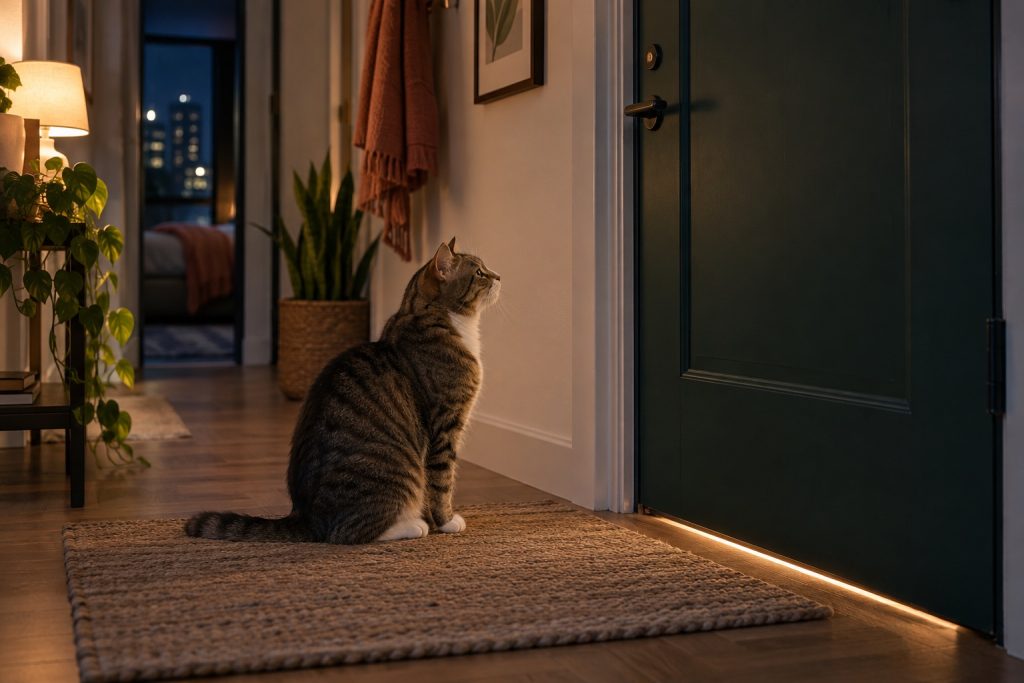
If your cat sits at the apartment door and meows after dark, the door itself is usually not the whole story. The hallway may carry unfamiliar footsteps, voices, food smells, dogs, or the scent of other cats. Your cat may also have learned that calling at the door sometimes produces attention or a chance to explore.
Start by ruling out a sudden health or welfare change. Then observe when the behavior happens, remove accidental rewards, and build a predictable evening routine away from the door. The goal is not to punish the sound. It is to understand what starts it and give the cat a safer, more useful alternative.
Quick diagnosis: what happens just before the meowing?
| Pattern you notice | A likely explanation | First thing to test |
|---|---|---|
| Meowing starts after footsteps, doors, or an elevator | Hallway sound or scent | Add steady background sound and move the evening activity zone away from the entry |
| Your cat has previously been allowed into the hall | Learned access-seeking | Stop opening the door in response to meowing and reward calm behavior elsewhere |
| It happens at nearly the same time every night | A learned routine or activity peak | Schedule play and a small meal before the usual start time |
| It began after a move or schedule change | Adjustment stress | Restore predictable feeding, play, and resting routines |
| It comes with pacing, appetite changes, litter-box changes, or disorientation | Possible medical or distress signal | Contact a veterinarian rather than treating it as a training problem |
1. The hallway is full of information
An apartment corridor can be more stimulating to a cat than it seems to a person. Air moves under the door. Neighbors cook, walk dogs, carry groceries, and open other doors. Elevators and stairwells add intermittent sounds. A cat may investigate the entry because it is the boundary between familiar territory and a stream of changing sensory information.
The Feline Veterinary Medical Association’s indoor-cat guidance emphasizes an environment that respects a cat’s sense of smell and other senses. That matters at an apartment door, where unfamiliar animal scents and cleaning products may arrive every day.
Try keeping a simple log for three nights. Note the time, nearby hallway activity, your response, and how long the episode lasts. A repeatable trigger is much easier to address than “random” meowing.
2. Opening the door may have trained the behavior
The ASPCA notes that a cat who wants to go outside can learn to meow at the door. The same learning can happen with an indoor apartment hallway. If meowing occasionally earns an open door, conversation, food, play, or even a long negotiation, persistence can pay off.
Intermittent rewards are especially confusing. Opening the door once after twenty minutes teaches the cat that twenty-one minutes may work tomorrow.
Before changing your response, make sure food, water, litter access, comfort, and health needs are met. Then choose one consistent rule. Do not open the apartment door because of vocalizing. Reward a quiet pause, a sit on a mat, or movement toward an activity station located away from the entry.
3. Your cat’s evening routine may end too early
Indoor cats need opportunities for play and predatory behavior. If the most active part of the evening happens after the household goes quiet, the apartment door can become the most interesting available target.
The Ohio State University Indoor Pet Initiative recommends scheduled play and notes that daytime activity may help cats sleep longer and bother caregivers less at night. A practical sequence is:
- Ten to fifteen minutes of interactive play.
- A brief cool-down with slower movements.
- A small meal or part of the cat’s normal food allowance.
- A quiet activity such as a puzzle feeder away from the front door.
Begin this sequence before the usual meowing time, not after the calling has already started.
4. The cat wants access to you, not the hallway
Sometimes the apartment entrance is close to a bedroom, work area, or the place where a person disappears at night. The cat may be requesting social contact or reacting to a closed interior door rather than trying to leave the home.
Look at the cat’s next move. When you approach, does the cat look toward the hallway, lead you to another resource, rub against you, or run toward the bedroom? That small observation changes the plan.
If the request is social, schedule several short, predictable interactions earlier in the evening. Avoid turning every nighttime call into a new play session. Reward calm approaches and quiet waiting during the day so the cat has a behavior that works better than calling.
5. A move or household change has disrupted predictability
Cats can be sensitive to changes in surroundings and routine. A new apartment, different work hours, a new roommate, construction noise, or a neighbor with a pet can make the entryway newly important.
The Ohio State University Indoor Pet Initiative describes routine disruption and unfamiliar environments as potential feline stressors. After a move, create a reliable refuge with resting, hiding, scratching, food, water, litter, and play opportunities. Let the cat expand into the home at its own pace.
Do not assume that hallway tours will help a recently moved cat “get it out of the system.” For some cats, access makes the hallway more valuable and increases door-focused behavior.
6. The apartment may need better activity zones
Small floor area is not automatically a welfare problem, but the cat still needs safe places, separated resources, play, predictable social interaction, and sensory control. These are part of the five pillars described by feline environmental-needs guidance.
Instead of filling the apartment with more objects, give each object a job:
- A stable perch or vertical route for observation.
- A scratching surface near a resting or transition area.
- A hiding place where hallway noise is muted.
- A food puzzle used at a predictable time.
- A short interactive-play route that does not end at the front door.
Our indoor living guides and boredom quiz can help you audit the environment without turning the apartment into a toy store.
7. Sudden or unusual vocalization can be a health signal
Do not treat every nighttime vocalization as a habit. A noticeable change in a cat’s normal voice or routine deserves attention, particularly in an older cat.
Contact a veterinarian if the meowing is sudden, escalating, or accompanied by any of the following:
- Appetite, thirst, weight, or litter-box changes.
- Pacing, confusion, staring, or getting stuck in familiar areas.
- Pain signs, reduced jumping, hiding, or sensitivity to touch.
- Vomiting, breathing changes, weakness, or other physical symptoms.
- Vocalization that occurs throughout the home rather than only at the door.
If you are unsure, record a short video and keep a time-and-trigger log to share with the veterinary team.
A seven-night reset plan
Night 1: observe before changing anything
Record the time, trigger, duration, and your response. Confirm that essential resources are available and note any health changes.
Night 2: move the action away from the door
Place the play route, puzzle feeder, resting spot, and reward mat several feet from the entry. Avoid creating an exciting station beside the problem area.
Night 3: start play earlier
Run a short hunt-style play session before the usual vocalizing window. Finish with food from the cat’s normal daily allowance.
Night 4: reduce hallway stimulation
Use a safe draft stopper if there is a large gap under the door, and add gentle, steady background sound near the sleeping area. Do not block ventilation or create a trapping hazard.
Night 5: teach a place behavior
Reward the cat for stepping onto a mat or perch away from the entry. Build the behavior during quiet daytime sessions before expecting it to work at night.
Night 6: make responses consistent
Everyone in the home should follow the same rule. Meet genuine needs, but do not open the hallway door or start an exciting activity in direct response to calling.
Night 7: review the pattern
Compare the start time, duration, and intensity with Night 1. Improvement may be gradual. If the behavior is unchanged, severe, or associated with other symptoms, involve a veterinarian or qualified feline behavior professional.
Apartment-friendly noise control
Behavior work takes time, so reduce sound transmission while the new routine develops:
- Put a washable runner or rug along the cat’s usual sprint path.
- Add felt pads to lightweight furniture that rattles.
- Store hard rolling toys overnight and offer quieter alternatives.
- Move climbing and jumping routes away from shared bedroom walls where possible.
- Keep the litter box, water, and a comfortable resting place accessible overnight.
Noise control should support the behavior plan, not replace it.
What not to do
- Do not shout, spray water, or use frightening motion devices at the door. Fear can increase distress without addressing the trigger.
- Do not open the apartment door after a long bout of meowing “just this once.”
- Do not add a second cat solely to solve vocalization. Some cats do not benefit from feline company, and introductions add resource and territory demands.
- Do not withhold normal food, water, litter access, social contact, or veterinary care in an attempt to stop the behavior.
Frequently asked questions
Should I let my cat explore the apartment hallway?
Unsupervised hallway access creates escape and injury risks and may violate building rules. Even supervised tours can make the hallway more rewarding. If you want to offer controlled exploration, first discuss safe harness training and identification with your veterinarian, and never open the door in response to meowing.
Will my cat eventually stop on its own?
Some short-term adjustment behavior fades as routines become predictable. A learned behavior that keeps receiving attention or access may persist. Track the pattern and address the trigger instead of waiting without a plan.
Should I ignore the meowing?
First rule out unmet needs, stress, and medical change. After that, consistency matters: avoid rewarding door-focused vocalization, and actively reinforce calm behavior in a better location.
Is a small apartment causing the problem?
Not necessarily. Usable vertical space, safe resting areas, separated resources, play opportunities, and predictable routines can matter more than floor area alone. Start with how the cat uses the space, not the apartment’s square footage.
Sources and further reading
- FelineVMA: Meeting the Physical and Emotional Needs of Indoor Cats
- The Ohio State University Indoor Pet Initiative: Basic Indoor Cat Needs
- The Ohio State University Indoor Pet Initiative: Increasing Activity
- The Ohio State University Indoor Pet Initiative: Feline Life Stressors
- ASPCA: Meowing and Yowling
PetPussyCat provides educational information, not veterinary diagnosis or treatment. Contact a veterinarian about sudden behavior changes or health concerns.