 PetPussyCat
Why Does My Cat Meow After I Turn Off the Lights?
A cat that meows after lights out may be reacting to a routine cue, seeking contact, expecting food, or feeling unsettled. Learn what to check and change.
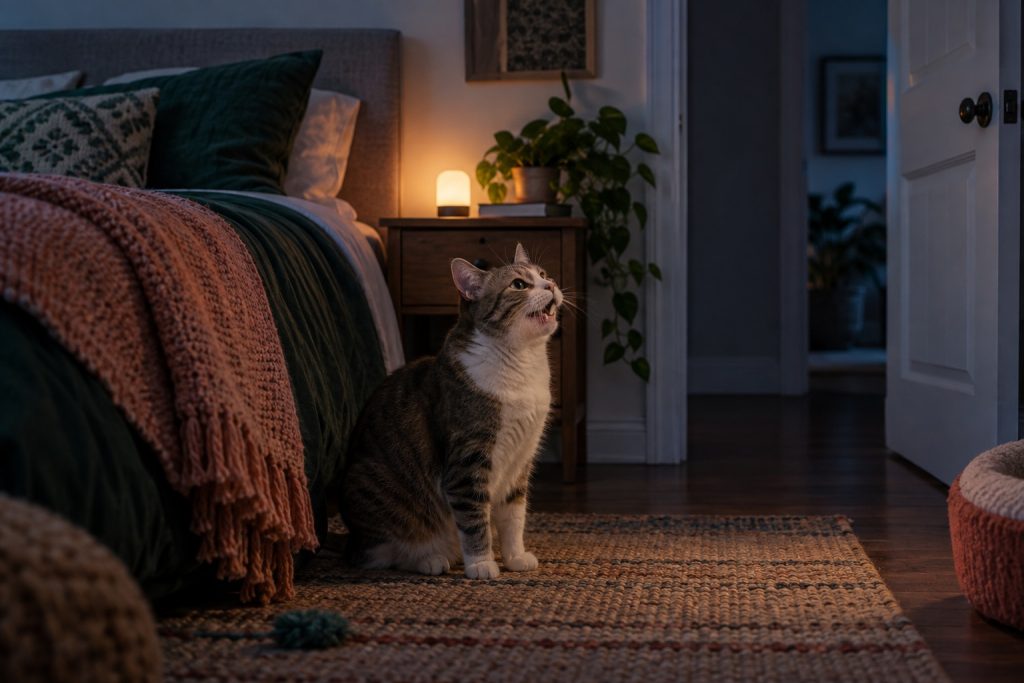
Turning off the lights changes more than visibility. It often signals that conversation, play, food, and access to a person are ending. A cat that meows at that exact moment may be responding to the routine rather than being afraid of darkness.
Watch what the cat does next. A cat that leads you to a bowl has a different request from one waiting at the bedroom door or reacting to hallway sounds. Start with essential needs and health, then adjust the cue and evening routine.
Quick guide to the pattern
| What happens | Possible explanation | First test |
|---|---|---|
| Meowing begins the moment the lamp clicks off | Learned bedtime cue | Move play and food earlier, then create a gradual wind-down |
| The cat waits outside a closed bedroom | Social access or learned attention | Set a consistent access rule and reward a quiet station |
| Meowing comes with door watching | Hallway sounds or scents | Reduce entryway stimulation and move activity away from the door |
| It happens just before breakfast | Food anticipation | Review feeding schedule; consider a timed feeder |
| An older cat wanders and seems confused | Sensory, cognitive, or medical change | Arrange a veterinary examination |
1. Lights out has become a powerful cue
Cats learn predictable sequences. If the lamp goes off just before a person disappears, the click may predict loss of access or attention. The vocalization can become stronger if it sometimes brings the person back.
Create a less abrupt sequence: active play, a small meal, ten minutes of quiet household activity, then dim lights and bedtime. Keep the order similar each night.
2. Your cat is requesting social contact
The ASPCA notes that cats may meow to seek attention and social contact. Before bedtime, provide a short, calm interaction when the cat is not vocalizing. Reward quiet approaches, sitting on a nearby mat, or settling on a bed.
Avoid teaching that repeated meows restart play. Meet normal social needs predictably during the day and early evening.
3. The cat still has unused energy
A quiet daytime schedule can leave the cat ready to run and play late at night. Add several small activity opportunities rather than one exhausting session. Food puzzles, climbing, supervised wand play, and short training games all count.
If running accompanies the calling, follow the routine in why cats get zoomies at night.
4. Food timing may be involved
Some cats vocalize because bedtime has previously included a snack, or because breakfast follows soon afterward. Keep portions measured. A timed feeder may help with predictable early-morning hunger, but a sudden increase in hunger or thirst needs veterinary evaluation.
5. A closed door changes access
The real trigger may be the bedroom door, not darkness. Scratching, pawing, and meowing that stop when the door opens suggest that access is important.
Choose one rule and follow it consistently. If the cat sleeps outside, provide water, litter access, a resting place, a scratcher, and a quiet food puzzle away from the door. Use our humane plan for bedroom-door scratching at night.
6. Apartment sounds become more noticeable
When household sound stops, elevators, neighbors, pipes, and animals in the corridor may stand out. A cat may orient toward the entrance, sniff under the door, or pause when footsteps pass.
Try steady low background sound near the sleeping area, a safe draft blocker if the gap is large, and evening activity away from the entrance. See the complete apartment-door meowing guide.
7. Stress or a recent change may disrupt the routine
A move, new roommate, construction, schedule change, or new animal can make bedtime less predictable. Restore consistent feeding, play, and resting times. Provide a quiet refuge with familiar bedding, hiding options, and easy access to essential resources.
8. New nighttime vocalization can be medical
Older cats may vocalize when disoriented, but age should never be used as a diagnosis. Pain, thyroid disease, kidney disease, sensory changes, and other conditions can alter nighttime behavior.
Contact a veterinarian if vocalization is new, escalating, or paired with weight, appetite, thirst, litter-box, mobility, breathing, sleep, or orientation changes. A short video and a written time log can help the veterinary team.
A practical bedtime reset
- Confirm water, litter, temperature, comfort, and health needs.
- Begin interactive play 20 to 30 minutes before the normal meowing time.
- Finish with a small portion of normal food.
- Offer a quiet resting station away from doors.
- Dim lights gradually instead of making lights out the first sign that interaction is ending.
- Reward quiet settling before the first meow.
- Keep every household member’s response consistent for at least a week.
Should you use a night-light?
A healthy cat generally navigates low light well, so a night-light is not a universal cure. It may be useful for an older cat, an unfamiliar home, or safe navigation around stairs and resources. Ask your veterinarian if visual or cognitive change is possible.
What not to do
- Do not shout, spray water, or use frightening devices.
- Do not withhold water, litter access, or necessary food.
- Do not assume every meow is manipulation.
- Do not repeatedly change the bedroom rule.
- Do not delay veterinary care for a sudden change.
Frequently asked questions
Is my cat afraid of the dark?
Usually, the routine change is a more likely explanation than darkness itself. Look at timing, location, and what stops the meowing.
Should I ignore the meowing?
First check welfare and health. If needs are met and the pattern is learned, avoid rewarding the call and reinforce quiet behavior earlier.
How long will a new routine take?
Some cats improve within days; established patterns can take longer. Track frequency and duration so small improvements are visible.
Sources and further reading
- ASPCA: Meowing and Yowling
- Ohio State University Indoor Pet Initiative: Sleeping Habits
- Ohio State University Indoor Pet Initiative: Feline Life Stressors
PetPussyCat provides educational information, not veterinary diagnosis or treatment. Contact a veterinarian about sudden behavior changes or health concerns.